Learning
Visiting Muhka with your class
Muhka offers an inclusive, inspiring and in-depth educational programme for all levels of education.
Our guided tours and labs encourage slow looking, critical reflection, feeling and creative action. We build bridges between art and education, society and imagination.
Guided tours
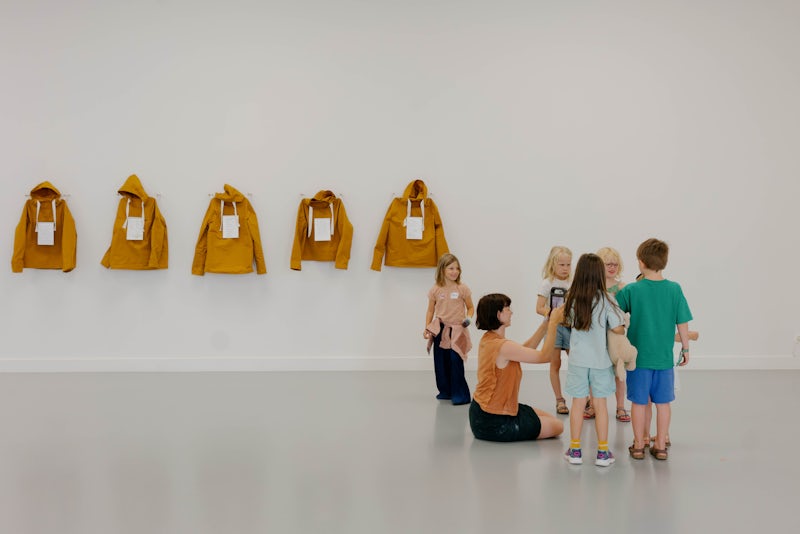
A guide takes the class on a journey of discovery through the museum, adapted to the pupils’ level. Together we look, interpret, philosophise about colours and forms, associate and make connections between art and the group’s world of experience.
This teaches pupils to look at images differently, formulate their own opinions and think critically about art and society. The focus is on high-quality, in-depth dialogue, curiosity and creativity.
Labs
During a lab, pupils explore the art of doing: experimenting with materials and media, investigating how images work and creating for themselves. The process comes first, not the end result: trying, failing, starting again and reflecting. This gives pupils insight into how contemporary art is created and functions.
Independent visit
Prefer to visit with your class without a guide? That is also possible. Teachers can guide their class themselves or prepare assignments. Let us know in advance when you are coming, so we can welcome you smoothly. Email reservatie@muhka.be.
Practical information
- Welcome from 09:00 – exclusively for school groups that have booked a guided tour
- Visits are possible from Tuesday to Friday.
- Guided tours start at 9:15, 11:00 or 13:00
- Labs start at 9:15 or 13:00
- Free transport – With dynamoOPWEG, you can travel to and from the museum for free with De Lijn.
- Reservations: at least 2 weeks in advance
+32 (0) 3 260 99 99
reservatie@muhka.be
For teachers and trainee teachers
Muhka actively supports teachers and trainee teachers in art education:
- Professional development & training on looking, guiding and working with art in the classroom.
- Annual Teachers’ Day, in collaboration with Klasse
Our vision
At Muhka, active meaning-making is central. Art is not a one-way process: pupils, teachers and supervisors become active participants in a meaningful dialogue with art, each other and the world. We encourage critical thinking, imagination and inclusivity, with attention to different learning styles and backgrounds. The quality of the activities always takes precedence over quantity.
Art helps us understand the world – and sometimes question it too.